

Alpacas of Oklahoma is dedicated to an on-going program of education concerning the health and welfare of alpacas in our region. Articles that appear in this section may be original contributions from our membership, reprints of previously published material pertinent to this region or contributions from universities and colleges. Serious studies, medical information and humor are all a part of the process of Alpaca Education.
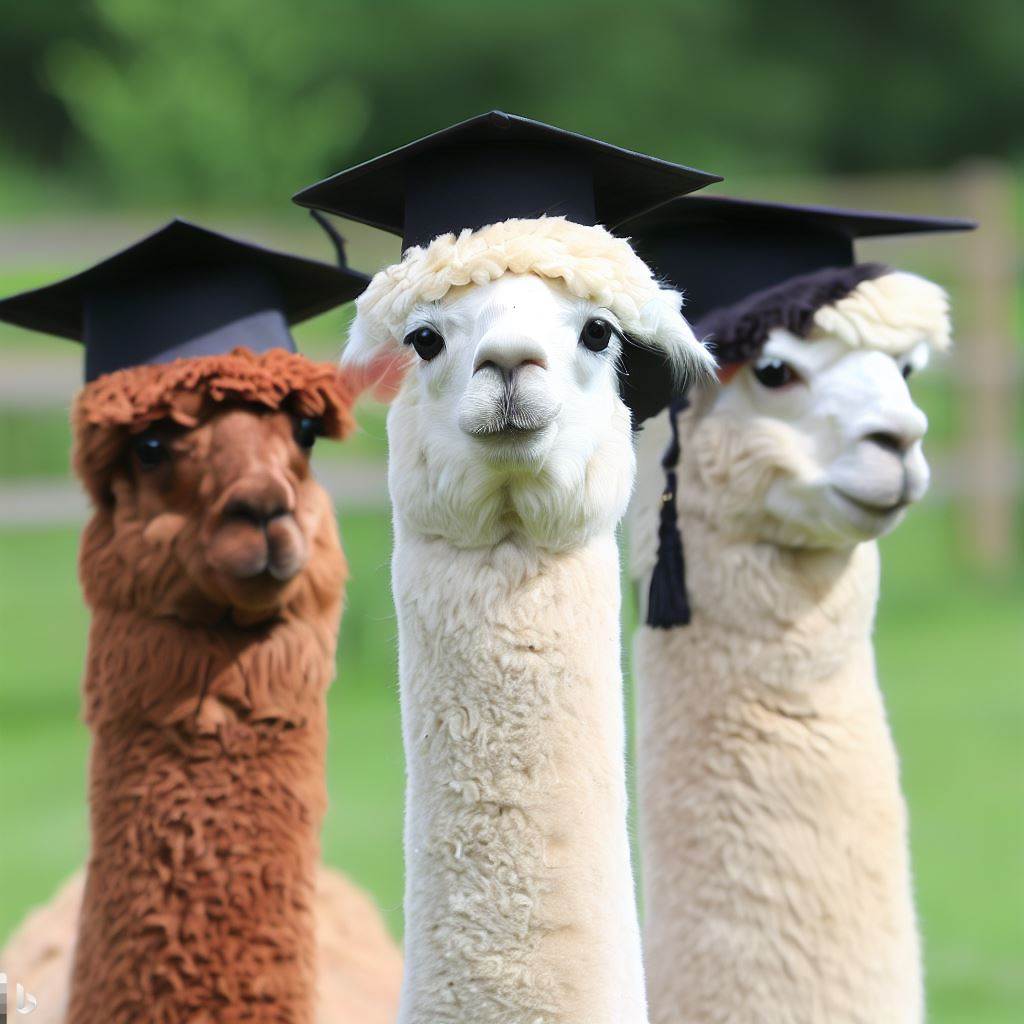
Be sure to join Alpaca Owners Association to gain access to their Alpaca Academy!
Basic Alpaca Care for Beginners – Quick and Dirty ‘Paca Care’
by Jo
Overbey
Rock Chimney Farm Alpacas
Physical Plant
Let’s begin with a discussion of the perimeter fence, as it is of primary importance. An alpaca’s only means of self-protection is to flee and we take that away from them by enclosing them in small spaces. Thus, a perimeter fence, which provides adequate protection from predators, is a basic requirement. Generally, the perimeter fence is of woven wire (2×4 or no-climb is preferred) with either barbed wire or electric wire along the exterior base to discourage digging. This wire is about 6 inches above the ground level. Also on the exterior, we recommend an electric wire about 2 feet above the ground to discourage predators from climbing in. The most effective electric box is the New Zealand variety, which packs a much greater punch than those routinely found in farm stores. The only source (that I know of) for these boxes is from someone who installs high tensile electric fencing. In our area of central Virginia, the primary predators are dogs, but we also have coyote, bear, and bobcats, which all pose a threat to alpacas. So, your perimeter fence should be at least four feet in height, and higher is always better.
While I am talking about predators, I will also mention that we employ two Great Pyrenees dogs for protection. For little more than the cost of dog food, I have ’round the clock security. In the cria paddock we also have a llama to provide an additional level of defense. Young guard dogs may not be completely trustworthy with young crias, as frolicking crias are often too much for a playful puppy to resist! A good guard llama, like Heather Marie, should discourage any rough play.
Pasture requirements are minimal, except it would be a kindness to offer them sufficient room to run. The rule of thumb is no more than 8 animals per acre, although I know of instances of greater numbers than that. One man who has 13 on one acre claims he still has to cut the grass! However, I like to opt for lower population numbers, as in dry weather you can find your paddocks overgrazed in a hurry. There should be a number of separate areas for segregating the males from the females. Ideally, you would have separate paddocks for breeding males, breeding females, and weanlings/juveniles. While discussing the ideal, a separate facility for the males would make life simpler. However, you can get by with mixing your animals a bit more, particularly when you are small and have only a few in each category. When planning your shelters and pastures, always plan for expansion – these animals are irresistable!
The interior of your barn should be as flexible as possible. Moveable partitions (corral panels) work well. Swinging gates can also be stratigically placed to change the configuration of the stalls. You’re only limited by your imagination! Alpacas are herd animals and like to be together, but can be stressed by cramped quarters, particularly at feeding time. I prefer an arrangement with a feeding station for each animal, and try to limit it to no more than two per stall. I use moveable plastic feeders that hang along the fence. Hay stations can be shared by a number of animals, providing there is good access for all. I recommend that the hay be fed from the ground, tubs have worked great for me. Using the tubs allow the alpacas to eat in a natural position, keeps the hay clean, and helps to keep their fiber clean.
Rubbermaid makes a durable water tub with rounded edges that works well as a hay container. You could also purchase a wooden hay box that holds a standard bale. It has a grate to hold the hay in the box, allowing the alpaca to remove only a mouthful at a time. I would discourage you from using vertical racks, as much of the hay would end up decorating their fiber. In your cria stall you can use the 50-gallon Rubbermaid tub which is low enough for the babies to use.
This winter we added automatic waterers to the girls’ barn and are delighted with them. I wish that we had installed them long ago! The boys still have heated buckets, which work well, but we plan on upgrading them also. If constructing your barn, give some thought to the flooring. There are a variety of materials available. I have seen rubber mats used over concrete floors – which are very nice, but a bit pricey. My experience is limited to dirt floors. In our girls’ barn, we use a fine gravel called screenings. We’re experimenting with using gravel dust in our boys’ barn. It’s put in about 6 inches thick, wet thoroughly, then packed with a roller. It seems to generate less dust than the screenings, but is very hard to come by — at least in our area. If you have a hard packed dirt floor, you might be able to just leave it at that. Our base was pipe clay and very definitely required covering up. You might also use screenings or quarry sand around the exterior to cover any muddy spots or where you don’t want grass. If you opt for a concrete surfaces, you’ll probably not have to trim nails as frequently, but remember that exposed concrete can be very cold in the winter months.
Alpaca Health
Alpacas are basically healthy animals and there is no disease that is specific to them. They are, however, subject to some diseases carried by other animals and require annual vaccination. We vaccinate based on the recommendation of our veterinarian, and suggest you do the same. Alpacas need a regular program of worming, but the amount of time in between depends on the area in which you live. All areas east of the Mississippi have large populations of white-tail deer, carriers of the meningeal worm, which is a most dangerous parasite for alpacas. This worm attacks the central nervous system and can be devastating to the animal’s health. If you have white-tail deer, you will need to worm monthly. Always, always, always consult your veterinarian!
Routine Care
Routine care won’t take a great deal of your time, but alpacas do require routine servicing! My daily chores consist of feeding, watering, and picking up the poop. I choose to feed twice a day because I like to. However, once a day is fine. My time spent at the barn is pure pleasure — Hutch has even offered to move my bed into a spare stall!
There are several varieties of pellets manufactured for llamas and alpacas specifically. In our area we generally supplement with pellets. Further west, where the hay is of better quality, you can get by with only supplementing your late pregnant and nursing females. Mazuri, Buckeye, and Southern States lama pellets are all appropriate feed, and readily found. I particularly recommend the Southern States mix, if you can get it. It is reasonably priced, and provides for the animals’ complete nutritional needs. Dr Norm Evans has a pellet mixture which is also quite complete and is produced by Agway. In addition to pellets, you will need to offer clean hay, either one of the grass hays or a mixture of grass hay and alfalfa. Pure alfalfa hay is too rich in calcium and protein and will cause an imbalance of nutrients, as well as fat animals. Also, I like to offer a mineral mix, free choice. There are several products recommended for alpacas and may be purchased through any of the camelid supply companies.
Fresh, clean water must be available at all times. It is not a good idea to have a source of water such as a pond or stream within your pasture area. They may stand in it in hot weather causing the constantly wet fiber to rot. It grows back, but you will have some unsightly animals until it does! We clean up the poop piles daily. I should note here that alpacas are very neat animals and their dung piles are often places for socializing. They all go in the same area and frequently at the same time. Clean-up is a breeze! Speaking of poop, if you haven’t caught a whiff – of that produced by alpacas – you’ll be surprised. I wouldn’t go so far as to call the scent fragrant, but I wouldn’t call it an odor either.
We trim our alpaca’s toenails, if needed, when we do monthly worming. The regularity of trimming does vary from animal to animal and according to the surface they walk upon. We have grass pastures which don’t wear the nails down, so most of our animals require a trim every month or so. Of course, these are fiber-producing animals. We shear annually in the spring, which also helps the animals deal with our hot, humid summers. From past experience, I now shear ALL my animals in the spring, including the spring crias. They may appear too young, but they can grow an incredible coat by July or August and really suffer as a result. Actually, the quality of the fiber at next shearing is also greatly improved, as that birth fiber can be just like velcro! I rarely shut the animals up in the barn. The exception was the “Blizzard of 1996†in which the wind and snow blew incredibly. I locked them up for two days until the weather calmed down, and I don’t believe any of them objected! Normally, they just need some shelter where they can get out of the elements in the winter, with straw bedding for warmth. The only other routine care is during the hotter months, as these guys are subject to heat stroke. This is a particular problem in the east where we have such high humidity along with high temperatures. You will need to provide shade and air movement for the hottest days. We use large industrial fans in the barns, placing them low to cool the alpacas’ bellies. Watching the ‘pacas hanging out in front of the fans, chewing their cud, will make you want to join the herd!
The most fun job for alpaca owners are hose parties. They get wet, you get wet, it’s hard to tell who’s having the most fun. Be sure to spray their bellies only, not the blanket area. Imagine wearing a wet wool jacket out in the sun, and you’ll appreciate the greenhouse effect as that wet fiber tries to dry. Trust me, stick to the belly. In central Virginia, our summers can get pretty warm. I like to spray almost daily. I’m not sure if it’s because I like to, or because the alpacas want me to — but we all have fun!
Breeding
Breeding camelids can be very interesting, as they are induced ovulators and unlike most of the species with which we are more familiar. They are unique to my experience, and that of most owners. There is limited space to go into all aspects of breeding here, but I would like to talk a bit about age. Females are capable of conception at quite a young age. At RCF, we always wait to breed until they are at least 18 months old, and prefer to wait until 24. It depends on the animal and the circumstances. Waiting a bit allows the female to achieve most of her growth before facing the demands of producing a cria. Long-term prospects for the animal are greatly enhanced by waiting a few more months before breeding. We not only refuse to breed at a young age, we will not purchase females that were bred at a young age. When we first got into the business, we were informed that males would not breed before 3 years of age. We bred our first male at 28 months and thought we were the cat’s pajamas! Now, I understand that some breeders are routinely breeding at 18 months. Hmmmmmmmm. This requires skill and knowledge on the part of the breeder, whereas if you wait until after 2 years, you can usually count on the male to do his part without your help!
Cria Care
Care of the newly born cria can vary considerably and is too involved to go into here. However, I would like to stress the importance of not upsetting the mom. The dam and cria need to bond with minimal interference and as little stress as possible. Occasionally we have had to supplement the mom’s colostrum with cow colostrum during the first 12 hours. But even trying to get that colostrum down must take a back seat to allowing mom and baby to bond. Typically, we find that the dams are perfectly capable of taking care of the cria. Our job is to disinfect the navel and to keep a sharp eye out that all is proceeding normally. It can be a bit nerve-wracking, but often the best thing an owner can do is to “sit on his handsâ€
We clear out all the other alpacas and leave mom and baby in a separate area for several hours, sometimes with an experienced female to serve as auntie. If it’s a pleasant day, you might put them in a small paddock for a little sun, preferably in view of the rest of the herd. It is always nice if the herd can meet the newcomer through the fence, as they seem to be anxious to greet and welcome the crias. These gals know how to tend their young and do a good job of it.
Recommended Reading
For further information, and more details, I recommend that you read the short book by Clare Hoffman, DVM, and Ingrid Asmus entitled Caring for Llamas and Alpacas, A Health and Management Guide. This book covers most of what you would need to know; and it has served well as a reference for me. I recommend it.
In this section, I have tried to give you an idea of what’s involved in caring for these enchanting animals. Of course, there’s always more than one way to get the job done. I hope I’ve been able to help you in your quest for information. Call me if I can be of assistance, but most of all, remember to have fun!
Jo Overbey
Reproduced from www.rcfalpaca.com with permission of Jo Overbey. Copyright © Rock Chimney Farm Alpacas
On-Farm Emergency Treatment of Alpacas
by David E Anderson, DVM, MS, Diplomate ACVS
International Camelid Institute
College of Veterinary Medicine
The Ohio State University
Unfortunately, emergencies occasionally occur on the farm. The successful resolution of any emergency depends upon our ability to recognize and effectively deal with the crisis. The typical “on-farm†emergencies include soft tissue injuries, choke, obstruction of breathing in new borns, and birthing difficulties.
Many owners have dealt with lacerations, abrasions, and other injuries caused by fighting, becoming entangled in fencing, falling, or malicious attacks by animals or people. Their are some rules-of-thumb we try to follow when dealing with these injuries. If the injury has resulted in debilitation of the animal or the animal is unable to ambulate (e.g., a tendon laceration), the injured alpaca should be made safe from continued trauma and the nearest veterinarian consulted. Sometimes, the best action is to not move the patient until the veterinarian has examined him/her. Moving can increase the severity of the injury and may result in a wound that is far worse than the original injury. If the animal is traumatizing itself by thrashing, then he/she should be moved to shelter or an area that has deep bedding. If you can keep the animal calm you should do so, but remember not to get yourself injured in the process! You should consult your veterinarian for all wounds that are full thickness through the skin (you can see muscle or fat through the wound). These injuries may be completely or partially restored if the veterinarian can treat the wound within 12 hours of injury. After this time, treatment becomes more complicated because bacteria have time to establish an infection in the tissues adjacent to the wound. While waiting for the veterinarian, you may rinse the wound with clean water to flush out any debris, but you do not want to put any antiseptics or ointments into the wound. Water soluble ointments (e.g. Furacin) are O.K. to use because they are easily washed out of the wound. However, lanolin or petroleum based antiseptics may not be able to be cleaned out of a wound, thus preventing suture closure of the wound.
If the wound is bleeding and is located on a limb, you may place a pressure wrap on the wound. This is done by applying a non-adherent dressing to the wound, wrapping a thick pad around the limb, wrapping the bandage with roll gauze using firm pressure, and wrapping over this with a non-adhesive wrap using more firm pressure. If the wound is located on the body, a similar bandage may be placed. Direct pressure may be applied to wounds on the head, but you should be careful not to apply excessive pressure. If the animal violently resists your efforts, the best thing to do is to put him/her into a quiet stall and wait for the veterinarian.
Wounds can be easily dealt with by planning ahead. A “First Aid†box should be kept on the farm and contain necessary emergency medical supplies. A large tackle box, tool box, or plastic storage box are ideal for holding items in a clean dry place. The box should be examined every six months to be sure that appropriate supplies are still in usable order. The following is a list of supplies you may want to keep on the farm is still being edited.
| Category | Item | Number In-Stock |
Ask your veterinarian to discuss the best methods to utilize your first-aid box so that it can be customized to your farm. Remember, your ability to handle emergencies is only as good as you are prepared to be.
Reproduced from www.vet.ohio-state.edu with permission of Dr. Anderson. Copyright © Dr. David Anderson
Mycomplasma Haemolamae in Alpacas
September 06, 2011
By: Internet Sources-Owning-Alpacas.com and Mike Six
Mycomplasma Haemolamae in Alpacas
Saving Your Alpacas’ Life
Saving your alpacas’ life from one of the known alpaca diseases that you may not have heard of, but should be aware of, is Mycomplasma Haemolamae (MH). It is a Silent Killer! MH has been detected since the 1990’s and was called Eperythrozoonosis or EPE. Recently the name has changed in the medical community for camelids, but it’s still the same disease. Alpaca health is very important to an alpaca business. Educating yourself about this disease will help protect your investment.
Important Information:
If you have an animal that is lethargic with chronic weight loss and has light or heavy anemia you should consider Mycomplasma Haemolamae (MH) as a possible cause and start tetracycline treatment immediately. Weight loss can be +/- ¾ of a pound per day, lethargy and anemia happens very quickly. Then the alpaca can die within days without treatment. The alpaca’s response will be quick and over the 10 days of treatment they will respond with weight gain, less lethargy and less anemia until they are back to normal and gaining their weight back in just a short period of time. (See Treatment below)
If you call your vet and they draw blood for testing, ask for the blood to be tested by Oregon State University. OSU has the only lab testing for MH in the country. OSU holds the patent for the process and I have not found another lab or university who performs the testing. If blood is sent for testing it must be in a purple top test tube, handled and processed properly and delivered imediately to OSU. OSU will provide your vet with the handling and shipping procedures, found on their web site. OSU does testing on Thursday’s and if your sample arrives late it does not get tested until the next testing day which is Thursday of the next week although they claim 1-3 days turn around. Results can be delayed causing death prior to recieving them. Also if the blood is handled improperly or the alpaca has had antibiotics or some types of worming medication prior to testing, the results can be affected. Treat your alpaca imediately and then wait for the results. You will find that if it is positive for MH your ahead of the dying curve. If it is negative you have not hurt your alpaca with tetracycline treatments.
Mycomplasma Haemolamae is a bacterium that attaches itself to the red blood cells of an alpaca. The immune system recognizes this as a problem and destroys the red blood cells. Your alpaca then becomes anemic. In the majority of alpacas infected with these bacteria, there are no signs of the disease. If your animal becomes immunocompromised through another one of the alpaca diseases or is stressed from a move or through other environmental changes, Mycomplasma Haemolamae can rear its ugly head. Because of the immunocompromised condition of the alpaca, other opportunistic parasites like strongyles, nematodes, coccidia, EMAC, clostridium A, B, C etc., can quickly infect the alpaca and Mycomplasma Haemolamae symptoms could be masked by the similar symptoms from these other parasites and illnesses. Many animals have died from Mycomplasma Haemolamae with an incorrect necropsy. Most vets and/or labs do not look for Mycomplasma Haemolamae during necropsy or even during standard blood panels. What usually comes back is anemia with high counts of white blood cells. This should be an alarm and treatment should start imediately to prevent death.
The disease can manifest as an acute problem. Your alpaca may suddenly be unable to stand and be extremely weak. Or it may be a chronic problem. As mentioned before, your alpaca may have chronic weight loss and lethargy. Anemia is one of the last symptoms to appear. Check for anemia by raising the eyelid of the alpaca. It should be bright pink and/or red looking (healthy) This is called the FAMCHA method found in the sheep and goat industry. Pale pink and/or white or almost white is close to death by intense anemia.
If you suspect infection with Mycomplasma Haemolamae, have your vet do a PCR (polymer chain reaction) test from OSU. This test amplifies the DNA so low levels of the bacteria can be detected on the red blood cells. In case you cannot get the PCR results back from your vet or lab in a timely manner like (1-3) days, start treatment immediately, especially if you have exhausted all other potential causes. This disease is a KILLER and once your alpaca is weak and down it is only days to hours to save their life, maybe.
This is one of the alpaca diseases thought to be spread by blood. Blood sucking insects such as biting flies, mosquitoes, lice, fleas, and ticks should be kept to a minimum on your farm. Only use a clean unused needle on each individual alpaca when giving injections. Needles are cheap. There is no reason to reuse a needle on another alpaca and risk the chance of transmitting any disease (besides, you dull the needle after the first use and it hurts more). Biting flies can be controlled by placing fly predators around poop piles and in areas of fly population. (search: (fly predators) on the net – they really work) Fly traps and Fly Stix help as well but do not elliminate the root of the problem like fly predators, they really work cutting the fly problem by 70 to 90% in a season. They last for 2-3 years or more without placing more. Having chickens free range with your alpacas can eliminate many parasites like ticks, (1 chicken can consume 500 ticks per day) fleas and other biting and sucking insects.
Treatment:
Mycomplasma Haemolamae is treated with tetracycline (LA200) (other brands of tetracycline are available but make sure they are the same strength as LA200) at your local farmer’s co-op a very common antibiotic. The dosage normally used is (.045) X (body weight) subcutaneously for 5 doses given every other day. Tetracycline is an over the counter drug and does not need to be prescribed by your vet. Check with a vet for dosages if you are unsure. Unfortunately, it appears that tetracycline does not completely rid the infected animal of these bacteria, but only lowers it to safe undetectable levels and save your alpacas life.
Once infected, an alpaca becomes a carrier known as a “tick†in the cattle industry. They will not have problems with the disease unless they become immunocompromised. This is an opportunistic bacterium.
The problem with having a carrier in your herd is that a fly could bite the carrier and then bite another animal passing on the bacterium. If you live near other livestock,(horses, cattle, sheep, goats etc..) this disease can be contracted from them via biting and sucking insects moving to your farm and making contact with your alpacas.
If you suspect Mycomplazma Haemolamae in an alpaca, you should probably test your whole herd and treat any animal with positive PCR results. Otherwise, you could have a reinfection of the disease. Not totally necessary if you are watching your alpacas closely for changes in normal conditions especially their weight. Young alpacas and cria seem to be affected much quicker that an adult. Probably because they weigh less and have less blood. Test and treat your suspected alpaca(s) who seem to have chronic weight issues. Then if positive consider doing others or all in the herd. Watch weight closely as it is the primary symptom that is recognizable without the interference of other opportunistic parasites.
Treated animals usually go on to live a long healthy life. Even though they have not gotten rid of the disease, they can live with it.
It’s important to weigh or evaluate alpacas when sheared or learn body scoring so you can spot a thin alpaca being a potential carrier of Mycomplasma Haemolamae. You should, also, require a PCR test from OSU before purchasing. The Mycomplasma Haemolamae carrier may look fine, but you bring them home and they infect your herd causing problems. Biting flys can be found everywhere and your alpaca can be bitten at your farm, during transport or even at an alpaca show and become a carrier back on your farm. A carrier can be healthly not showing signs for months or even years.
Here’s a couple of interesting facts about camelid red blood cells:
• They have a lifespan of 235 days vs. 100 days for human red blood cells
• Camelids have oval red blood cells instead of round like other mammals. This gives them a larger surface area so there is better oxygen exchange which helps them survive at higher, thinner air altitudes in their native South America.
The unusual shape of an alpaca’s red blood cell makes understanding alpaca diseases a challenge to veterinarians.
Mycomplasma Haemolamae is thought to be in 25% or more of Camelids (alpacas and llamas) in the United States. More studies are being done to try and eliminate alpaca diseases. Until something better is found for Mycoplasma Haemolamae, keep the insect population down on your farm and test and treat to keep it in check if present.
Remember: Your Vet Does Not Save Your Alpaca’s Life. YOU DO!
“I am not a vetâ€, but an experienced alpaca owner. When I say experienced I mean, having experienced the effects of this silent killer disease first hand. I have seen animals die on my farm and other farms, with most necropsies determining the death of the alpaca was from common parasites, heat stroke, failure to thrive or some other educated guess from the vet(s). This is done without the exact testing for MH. Without these tests it is the vet’s best guess. Remember, other parasites become opportunistic during the process of this disease. The alpaca cannot fight anything else because it is busy fighting MH by attacking its own red blood cells, hence anemia. The alpaca dies quickly. Once you see an alpaca die from this disease with all parasite and other medical treatments doing nothing to stop it you will never let it happen again! I am not a vet, but an experienced alpaca owner. If you are not sure about the information I have given, call your vet and discuss MH with them prior to treatment, then get a second opinion and maybe a third.
My personal opinion is that hundreds if not thousands of alpacas have died in the U.S. from MH without the knowledge of the vet or the owner. Many times the death is blamed on something else, failure to thrive, heat stroke, internal parasites etc. How many times was this just an “semi-educated guess� I think many! When you hear of multiple death’s on an alpaca farm(s) around the country it creates the alpaca disease of the year fear. Every year something new hits, SNOTS, EMAC, Barber Pole Worm and so on, and the blame is placed unknowningly on the new found disease of the year. Then the “experts†begin to give a series of seminars on the new fear. Be safe rather than sorry and treat for MH during these so called outbreaks and you may save your alpacas’ life.
Giving LA200 in the dosage mentioned earlier is Risk Free and can do nothing to harm your alpaca, and it can’t hurt even if the alpaca is by chance, ill from something else. Most vets do not recognize this disease and little is written about it, even in the Norm Evans field manual, it is just a mention. Most of the articles I have found do not stress the seriousness or deadliness of MH.
Educating yourself can save your alpaca investment, money spent on vet assistance and your alpacas.
Feel free to copy this information and pass it to other alpaca owners. Knowledge is Power!
Be aware, I am not a trained vet and many may poo poo this article. I say, poo poo back! Time will tell…. To date, passing this information has saved many alpacas and I am sure many more to come!
Thank you for the information about MH found on the web at: owning-alpacas.com, OSU, and other internet sites reviewed, (the word is getting out and alpaca lives are being saved), but even as you read this there is an alpaca dead or dying from Mycomplasma Haemolamae unknown to the owner and their vet.
Alpaca owners, potential owners vets’, techs’ if you would like to discuss this further or if you have any questions contact me anytime.
Michael Six
Owner/Operator
Morning Moon Alpacas, Inc. http://www.morningmoonalpacas.com/
417.235.5171
Spit and the Human
~ As re-told by Ed Downs, Kindred Spirits Ranch
July 29, 2007
Many believe that alpaca’s intentionally sprawl out in the middle of a paddock, heads flung back and legs all a dither, purely for the fun of making alpaca owners think they have died. In some cases they sleep so soundly that true fear enters the picture. But, there is another truth.
Alpacas possess a mystical quality that transcends our understanding of space and time. During these periods of disturbing repose they, it is said, visit a magical place wherein exist a marvelous school of alpaca learning. This mythical university is proctored by famed alpacas of the past and present who teach young alpacas how do deal with the strange, but sometimes amusing and endearing, world of bipedal humanoids. Let’s listen in as a grand and wizened old alpaca, still rich in his chocolate color and wise through his long years with humans, lectures on the relationship of “Spit and the Human.†Professor Hershey begins:
“Many of the human species who co-inhabit our physical world think that the camilid behavior of “spitting†is both strange and disgusting. Nothing could be further from the truth.†Professor Hershey leans upon a rail and studies the impact of his shared wisdom. “As you know, we alpacas do not need a spoken language to communicate. Unlike humans, who have lost their primal communications skills, we alpacas use a complex language of body movement, posturing, sounds and eye contact to communicate a wide variety of social rights and wrongs. The position of our tails, shifting of weight form one leg to the other, the twitch or position of an ear or perhaps a focused gaze at a distant object all clearly communicate needs, social standing and even danger. While humans seem unwilling to learn how to understand our vocal talents, we do posses a large vocabulary, consisting of complex sounds, each having specific meaning.†Now, with a sigh, Professor Hershey laments, “But, alas, all of our highly developed communication techniques can fail when we feel challenged or angered, especially if by one of our own who steps out of the social order.â€
Professor Hershey, his tone more serious, continues, “When all else has failed, we express our displeasure by hocking up a really good loogy and launching a well placed spit. When done with skill, careful aiming and velocity, the effect can be alarming. A good, stinky spit (we call that a “third stomach zingerâ€) will truly impress your adversary with your resolve and may end the conflict at that moment. Unfortunately, engaging in a long spitting match will end up as quite self defeating, in that your lower lip will become anesthetized. This prevents you from eating, which is probably what the spitting match was all about to begin with.†“Regrettably,†laments Professor Hershey, “Many of our humans think that our spit was purposely aimed at them, thus a reputation that has earned us the standard first question of all newcomers to the world of alpacas. Do they spit?†With a mischievous grin, the Professor adds, “But this reputation can be used to our advantage. “Rosita,†Professor Hershey calls out to a beautiful rose-gray little girl, as he picks up a stack of papers, “Would you be so kind as to pass this flyer to the rest of the class? There will be a quiz at the end of the week.â€
The hand-out reads as follows;
Spit and the Human
- Spit is a useful psychological tool in the training of humans. The very fact that most humans, when asked “do they spit†will firmly answer “NO,†means that they are willing to make excuses for you and do your biding. This is an important first step in gaining control over your human.
- Always fold your ears back and establish a wide eyed visual contact with your human before you spit. This will train them to respond to you without the need to actually spit, the results of which could interfere with your fair share of the food.
- Quickly establishing the “armed and ready†look will train your human to get your food to you faster.
- Adult females should use spit freely as a means of disciplining crias when they step out of their social standing or interfere in adult issues. Hopefully humans will learn form this and spit at their crias when allowed to run lose amongst pens at an alpaca show or while in human feeding areas. It has been reported that some humans even allow their crias to make great noise while in flying machines and, worse yet, interrupt human communication between adults. Let’s see if we can help humans understand the value of a good, up form the deep, spit.
- Occasional, the males in a herd should demonstrate the tactics of a well thought our spitting match between several advisories. It is important for humans to see how silly the entire event looks. Hopefully, human males will see that the result of physical conflict is that none of the participants can eat and breeding may be difficult. Perhaps humans will learn that spitting is significantly more earth friendly than guns, bombs, terror, violent intolerance or nuclear weapons.
- Last, but not least, occasionally display all the signs of getting ready to spit, then change your mind and give your human a kiss. This will completely disarm them and keep them coming back for more.
Professor Hershey smiled faintly as the class read the hand-out, and then dismissed the group. All in attendance returned to their paddocks and arose, refreshed and ready to hock up a good one.
Joining Us is the surest way to expand your Alpaca Education!